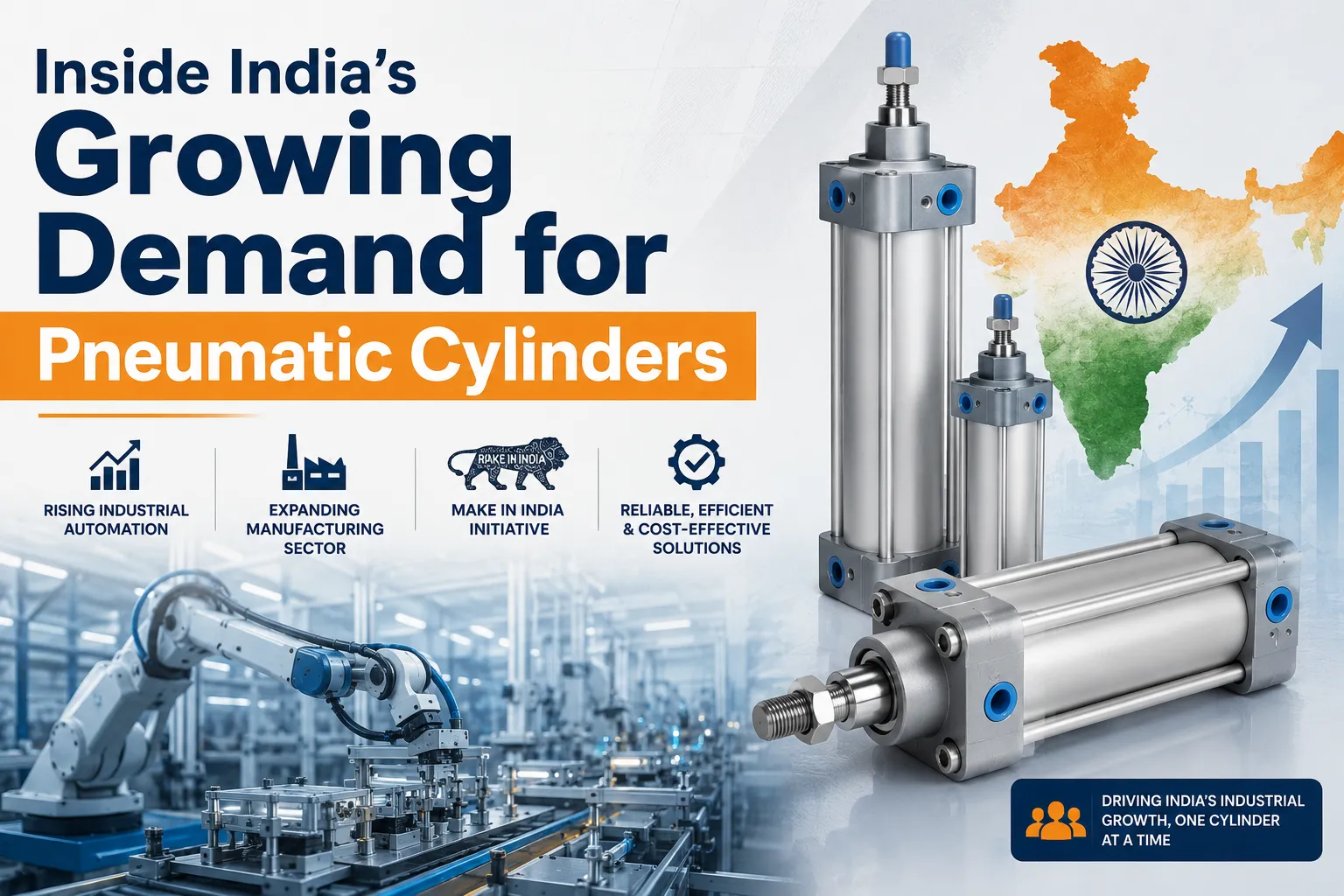
Industrial buyers stopped asking whether automation is necessary years ago. The real argument now is about uptime, replacement cycles, and whether a supplier can deliver Pneumatic Cylinders fast enough when a production line suddenly expands from one shift to three. Across India, especially in automotive, packaging, pharmaceuticals, and food processing, pneumatic systems are moving from “support equipment” to production-critical infrastructure.
And yet, many procurement teams still treat cylinders like commodity parts.
That mistake gets expensive fast. A poorly machined bore, inconsistent seal quality, or weak piston rod plating can shut down an assembly line that loses ₹2.8 lakh in a single afternoon. Buyers usually notice the problem only after installation — not during inspection.
India’s industrial automation market crossed USD 15 billion in recent estimates, and pneumatic systems remain one of the most widely adopted motion-control solutions because compressed air infrastructure already exists in most factories. That’s a major reason why demand for Pneumatic Cylinders manufacturer networks and pneumatic cylinder suppliers in India has increased sharply over the last five years.
The Spec Detail Most Buyers Skip While Ordering Pneumatic Cylinders
A surprising number of buyers focus only on bore size and stroke length.
That’s not enough.
Rod Material Changes Everything
Most failures don’t begin inside the cylinder barrel. They begin at the rod surface. Poor chrome plating thickness causes micro-pitting, especially in humid environments like Gujarat’s coastal manufacturing zones or chemical plants around Vapi.
Which means a cylinder that looked fine during dispatch may start leaking compressed air within six months.
A good Pneumatic Cylinders manufacturer will specify:
- Hard chrome plated piston rods
- Corrosion resistance rating
- Seal compatibility
- Operating pressure range
- Cushioning options
Bad suppliers usually reply with “standard quality.” That phrase should worry buyers immediately.
Bore Size vs Actual Load Conditions
Factories often oversize cylinders thinking bigger automatically means stronger. It doesn’t. Oversizing increases compressed air consumption and operating cost.
For example:
- A 100 mm bore cylinder can consume nearly 4 times more air volume than a 50 mm bore in repeated cycling applications.
- On high-cycle packaging lines running 18 hours daily, that difference becomes noticeable on compressor load and electricity bills.
Most buyers discover this late.
The Cushioning Issue Nobody Mentions Early
Cylinder cushioning matters more in high-speed automation than many purchasing teams realise. Without proper cushioning:
- End-cap impact damages seals
- Fasteners loosen over time
- Alignment issues appear earlier
- Machine vibration increases
That repair cost rarely gets calculated during procurement.
Mechanical Push Button Valve Compatibility
Many automation systems still depend on Mechanical Push Button Valve assemblies for manual control applications, emergency actuation, or operator-assisted production setups.
Here’s where compatibility matters:
- Port sizing
- Pressure rating
- Response sensitivity
- Mounting alignment
A mismatch between cylinder specifications and Mechanical Push Button Valve setup creates inconsistent actuation timing. Operators compensate manually at first. Then production accuracy drops.
5 Supplier Evaluation Points That Actually Matter
1. Ask for Failure Data, Not Just Catalogues
A serious supplier tracks recurring failures.
If a vendor cannot explain their most common warranty issue from the last 12 months, they probably don’t monitor field performance properly.
Bad answer:
“We rarely get complaints.”
That usually means documentation is weak.
2. Check Lead Time Consistency
One delayed shipment can stall an entire OEM production schedule.
Indian manufacturers supplying export buyers often prioritise larger overseas orders first. Smaller domestic buyers sometimes discover their “7-day dispatch” suddenly becomes 19 days.
That delay affects everything downstream.
3. Audit Seal Quality
Cylinder performance depends heavily on seal material quality. Nitrile, polyurethane, and Viton seals behave differently under heat and chemical exposure.
Most catalogues won’t explain the trade-offs properly.
A supplier who avoids discussing seal composition is hiding something.
4. Verify Machining Tolerances
Cheap machining shows up later as:
- Rod wobble
- Air leakage
- Uneven piston travel
- Premature seal wear
That’s harder to fix than buyers expect because replacement usually means line stoppage.
5. Evaluate Valve Integration Knowledge
Many Pneumatic Actuator Valve failures happen because the supplier understands the valve but not the application environment.
Good Pneumatic Actuator Valve Manufacturers in India ask:
- Duty cycle frequency
- Air quality condition
- Temperature exposure
- Manual override requirement
Weak suppliers just quote pricing.
Why Industrial Buyers Still Prefer Pneumatic Systems
Pneumatic Systems Require Less Upkeep than Instead of Hydraulics
Hydraulics does provide high force, however, they come with added maintenance due to the risk of leaks and contamination with oil.
Pneumatic systems remain cleaner for:
- Food processing
- Pharma manufacturing
- Electronics assembly
Especially in India’s FMCG sector, compressed-air automation is often easier to maintain across multiple factory shifts.
Faster Cycle Speeds
Pneumatic Cylinders work well in repetitive, high-speed applications where precise linear movement matters more than extreme force.
That includes:
- Pick-and-place systems
- Conveyor diverters
- Carton forming
- Labeling machinery
Cycle efficiency directly affects production output.
Easier Replacement and Lower Downtime
A standard pneumatic cylinder can often be replaced in under 40 minutes if spare inventory exists onsite.
That matters.
Some imported automation systems take weeks for replacement components. Indian factories increasingly prefer locally available Pneumatic cylinder suppliers in India because downtime penalties are growing harsher under contract manufacturing agreements.
Mechanical Push Button Valve Systems Still Matter
Automation hasn’t removed manual intervention completely.
In maintenance bays, semi-automatic systems, and emergency override stations, Mechanical Push Button Valve systems remain widely used because operators trust direct tactile control during troubleshooting.
That practical reliability still matters on real factory floors.
Pneumatic Actuator Valve Systems Improve Process Control
Modern Pneumatic Actuator Valve systems allow:
- Faster shutoff response
- Safer process isolation
- Reduced operator intervention
- Better remote automation capability
And yet, buyers still underestimate actuator sizing errors.
A Pneumatic Actuator Valve Suppliers company that only discusses pricing without reviewing torque calculations is setting the customer up for operational problems later.
Why India’s Supply Chain Is Favouring Domestic Pneumatic Manufacturers
Import dependency created problems after 2020.
Freight disruptions, container shortages, and inconsistent customs clearance forced many Indian OEMs to rethink sourcing strategies. Buyers who once waited 8–10 weeks for imported cylinders began shifting toward domestic suppliers with stable inventory programs.
That trend continues.
Haryana, Maharashtra, Gujarat, and Tamil Nadu have increasingly robust industrial clusters for manufacturing pneumatic components. In India, unlike in many other countries, domestic transport won’t just delay movement. It can, and often does, disrupt production schedules.
A supplier operating near major freight corridors usually delivers more reliably during peak industrial periods.
About V.S Enterprises
At V.S Enterprises, we work closely with wholesalers, OEM buyers, procurement teams, and industrial distributors looking for dependable pneumatic automation components across India. We’ve seen buyers struggle with inconsistent bore tolerances, poor seal quality, and shipment delays that nobody admitted upfront.
We focus on details.
- Consistency of pressure testing
- Quality of rod finishes
- Compatibility of valve integrations
Protection of packaging during long distance transport
In 2021, we altered a method of exporting after several complaints from buyers about damaged goods because of shipping mixed cargo through western ports.
That adjustment reduced replacement claims noticeably within two quarters. Factory feedback teaches lessons faster than presentations ever will.
Our range includes:
- Pneumatic Cylinders
- Mechanical Push Button Valve systems
- Pneumatic Actuator Valve assemblies
- Industrial pneumatic accessories
And we continue supplying industrial buyers across India and export markets.
Send Technical Specs Before You Ask for Pricing
Most quotation problems begin because buyers send incomplete information.
Before contacting us, send:
- Bore size
- Stroke length
- Working pressure
- Mounting style
- Application environment
- Required quantity
- Delivery location
We usually respond within one business day for standard enquiries. MOQ depends on the product category and customization level, especially for Pneumatic Actuator Valve assemblies and bulk OEM requirements.
Conclusion
India’s industrial automation growth is pushing demand for Pneumatic Cylinders far beyond basic manufacturing applications. Buyers now care about delivery reliability, machining quality, valve integration, and long-term operating cost — not just unit pricing. The suppliers gaining trust are the ones solving production problems before shipments leave the factory. Over the next few years, Indian manufacturers that combine technical consistency with faster local supply chains will likely shape the next phase of pneumatic automation growth.
Here is another blog you might be interested in.
Mechanical Push Button Valves: Small Component, Big Impact
FAQs
Which industries prefer using pneumatic cylinders in India?
The industries using the most pneumatic cylinders in India include automotive, packaging, pharmaceuticals, food processing, textile machinery, and FMCG. Higher demand has been noted in warehouse automation and systems that include conveyor handling in the past three years.
How can I assess the quality of pneumatic cylinders’ manufacturers?
Request information on standards of machining tolerance, seal specifications, technical documents on pressure tests, and statistics on failure rates. Suppliers that stay clear of technical conversations and repeat the term “industrial standard quality” are most likely lying about their process.
Is the Mechanical Push Button Valve system relevant in the automated factory of the future?
Yes. Fully automated systems should have points of manual override, maintenance, and emergency stops. Mechanical Push Button Valve systems are common in semi-automated systems of production and maintenance of machines.
What is the reason for favoring Indian pneumatic cylinder companies over international suppliers?
Global supply chain disruptions affected how and where deliveries are made. In-country sourcing minimizes replacement wait times and long downtimes in factories. However, not all suppliers in the country consistently meet sealing and machining standards, hence supplier audits are crucial.
What must buyers consider before ordering from Pneumatic Actuator Valve Manufacturers in India?
Buyers must factor in the torque to be applied, operating pressure, the number of cycles, the compatibility of media, and the conditions. Buyers tend to make sizing errors for pneumatic actuators more than is commonly assumed, especially for the chemical, and process industries.
Do suppliers of pneumatic valve actuators tend to have stock on hand?
It varies. Stocking standard models is pretty common. However, if customized designs are requested, those may take longer. When purchasing for a scheduled maintenance shutdown, it’s best to check lead times to see if and when stock will be available.
What are the common reasons for the failure of pneumatic cylinders?
Side loading, lack of air quality, rod corrosion, seal wear, and incorrect sizing lead to the most common failures. Pneumatic cylinders of poorer quality fail earlier because of a lack of consistency within the machining tolerances, despite even finishes.