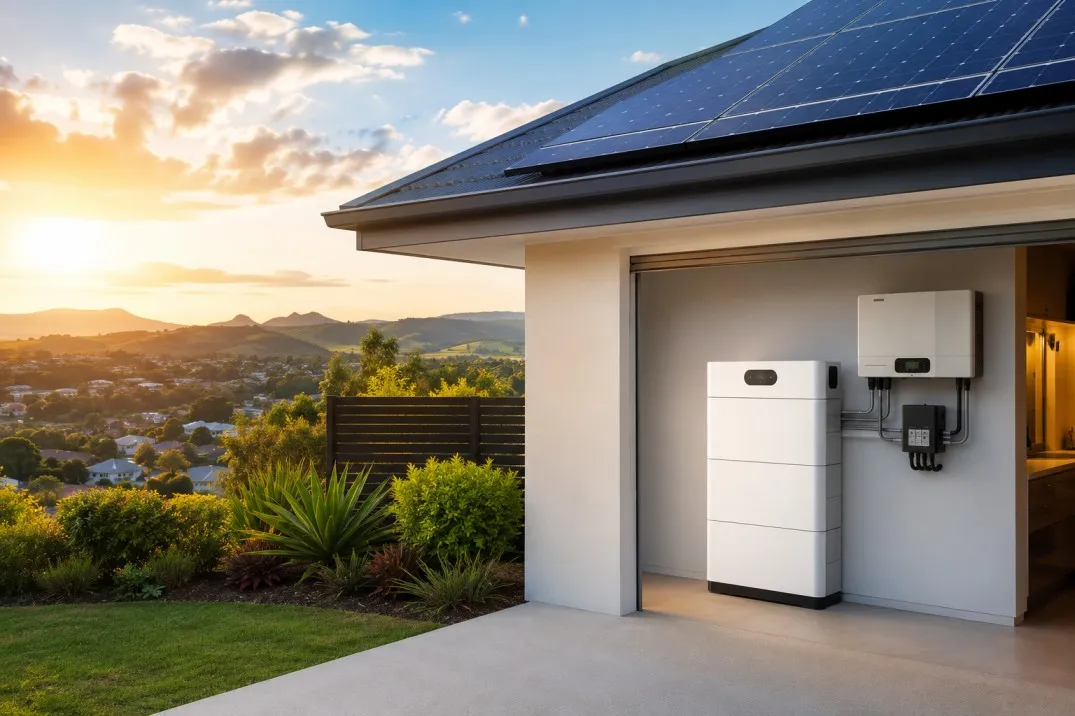
For homeowners in Canungra and the surrounding Gold Coast hinterland, reliable access to electricity can be an important part of everyday life. Local properties range from homes close to town to larger rural blocks, and each can have very different energy requirements.
Solar battery storage offers one way to store electricity generated by rooftop solar for use at another time. Depending on how a system is designed, battery storage may also provide selected backup capabilities when grid electricity is unavailable.
However, choosing battery backup Canungra homeowners can rely on involves more than selecting a battery based on its advertised capacity. Household electricity consumption, existing solar equipment, backup priorities, property characteristics and installation requirements should all influence the decision.
A locally informed, property-specific assessment can help homeowners understand which battery configuration is appropriate rather than relying on a one-size-fits-all package.
1. Start With Your Actual Energy Requirements
Before comparing batteries, consider what you want the system to achieve.
Some homeowners primarily want to store excess rooftop solar electricity generated during the day and use it later. Others place greater importance on maintaining power to selected essential appliances or circuits during certain grid outages.
Rural and hinterland properties can have additional considerations. Pumps, refrigeration, communications equipment, gates and other electrical loads may influence energy requirements depending on the property.
This is why planning battery backup Canungra should begin with an assessment of actual electricity usage.
Reviewing electricity bills is useful, but consumption patterns matter too. A household that uses most of its electricity during daylight hours may have different storage requirements from one with substantial evening and overnight consumption.
A battery should ideally be sized around realistic usage and objectives rather than simply choosing the largest capacity available.
2. Understand That Not Every Battery Automatically Provides Blackout Backup
One of the most important points to understand is that installing a solar battery does not necessarily mean your entire home will continue operating normally during every grid outage.
Backup functionality depends on the battery, inverter, system configuration and supporting equipment.
Some systems can be configured to supply selected essential circuits. Others may provide broader backup capabilities depending on system design and available battery power.
The Australian Government’s Solar Consumer Guide explains how rooftop solar and batteries work and provides independent information for households considering energy storage. Government guidance notes that an appropriately configured islandable solar-and-battery system can disconnect from the grid during an outage and continue supplying electricity, with solar potentially recharging the battery when conditions allow.
If backup power is your main reason for researching battery backup Canungra, tell your installer this at the beginning of the consultation.
Be specific about what you want powered during an outage so the proposed system can be designed around realistic priorities.
3. Decide Which Loads Are Most Important During an Outage
Trying to power every electrical appliance during an outage can require substantially different equipment and storage capacity from maintaining only selected essential loads.
Think about what genuinely needs to keep operating.
For many households, priorities might include refrigeration, lighting, communications equipment and selected power outlets. A rural property could have additional essential electrical requirements depending on its setup.
High-consumption appliances can use stored energy quickly, so understanding load requirements is important when designing battery backup Canungra systems.
Ask your installer which circuits the proposed backup configuration will support and for approximately how long under different usage scenarios.
Backup duration cannot be guaranteed as a fixed number of hours because it depends on available battery charge and how much electricity is being consumed.
A battery that lasts comfortably overnight under modest loads may discharge considerably faster if multiple high-power appliances are operating.
4. Match Battery Capacity to Your Property
Battery capacity is usually expressed in kilowatt-hours, or kWh, but selecting the right capacity involves more than choosing the biggest number.
Consider how much excess solar energy is normally available to charge the battery and how much electricity the household uses after solar production falls.
Usable capacity is also important.
The advertised or nominal capacity and the amount of energy practically available for regular use may differ depending on the product and operating settings.
When comparing battery backup Canungra, ask the installer to explain both capacity and expected usable storage in straightforward terms.
An oversized battery may increase the upfront investment without necessarily delivering proportional benefits if there is insufficient solar generation or household demand to use it effectively.
An undersized battery, meanwhile, may not provide the level of storage or backup capability you expected.
Good sizing requires property-specific information rather than assumptions.
5. Consider Your Existing Solar System
If your property already has rooftop solar, battery compatibility should be assessed before selecting a product.
The age and type of inverter, solar array capacity and existing electrical configuration can all affect battery options.
Some installations may use an AC-coupled battery arrangement, while others may be suited to different configurations. The right approach depends on the existing system and your objectives.
A local assessment is particularly useful when planning battery backup Canungra for an older solar installation.
Ask whether your existing inverter can remain in place, whether additional equipment is required and how solar generation will interact with the battery.
If backup functionality is required, ask specifically how the system will operate when grid electricity is unavailable.
A clear explanation before installation can prevent incorrect assumptions about what the completed system will be able to do.
6. Account for Rural and Hinterland Property Needs
Canungra is surrounded by hinterland and rural areas where properties can differ considerably from typical suburban homes.
Some may have larger electrical loads, detached buildings or equipment associated with acreage living. Others may face situations where extending or upgrading grid infrastructure is complex or costly.
These characteristics can influence whether a conventional grid-connected solar-and-battery system, a hybrid configuration or an off-grid solution deserves consideration.
For rural battery backup Canungra projects, a detailed site assessment becomes particularly valuable.
An installer may need to consider existing electrical infrastructure, distance between equipment, available installation locations and how critical loads are distributed around the property.
Off-grid systems require especially careful design because generation and storage must be planned around the property’s energy needs without relying on normal grid availability.
Homeowners should avoid assuming that a battery added to a standard solar system is equivalent to a purpose-designed off-grid energy system.
7. Choose Battery Placement Carefully
Where a battery is installed is an important safety and performance consideration.
Battery systems cannot simply be positioned wherever there happens to be free wall space.
Queensland Government guidance on battery safety and maintenance explains that battery placement must account for safety requirements, suitable clearances, ventilation and potential hazards.
Factors such as direct sunlight, heat, moisture, vehicle movement and access can influence whether a location is suitable.
Australian standards also restrict battery installation in certain areas of residential buildings.
For battery backup Canungra, local property characteristics may create additional placement considerations, particularly on acreage or rural sites with sheds, garages and detached structures.
The final location should be determined through proper assessment rather than convenience alone.
8. Think About Canungra’s Local Conditions
Local knowledge can add practical value when designing a solar-and-battery system.
Canungra and the surrounding hinterland include a mixture of residential, semi-rural and rural properties. Roof layouts, vegetation, shading and electrical infrastructure can vary considerably from one site to another.
Trees and surrounding terrain may influence solar generation at certain times of day, while the available space for solar panels can affect how much electricity is available to charge a battery.
These factors mean that battery backup Canungra should ideally be considered as part of the property’s complete energy system.
A battery does not generate electricity by itself. Its usefulness is closely connected to where its stored energy comes from, how much is available and when the household consumes it.
Local site assessment allows these factors to be considered before equipment is selected.
9. Understand Solar Generation and Battery Charging
A solar battery generally stores electricity that can be used later rather than exporting all excess generation immediately to the grid.
How effectively this works depends on the relationship between solar generation, household consumption and battery capacity.
During daylight hours, solar electricity may first supply household loads, with available excess energy charging the battery depending on the system configuration.
Stored energy can then be used later when solar production is lower or unavailable.
For homeowners considering battery backup Canungra, it is useful to ask for an explanation of expected daily energy flows.
Understanding when your home generates, consumes, stores and imports electricity can help you evaluate whether the proposed battery capacity makes sense.
Seasonal variation should also be considered. Solar generation is not identical every day of the year, so battery performance and charging patterns can change with weather, season and household behaviour.
10. Compare Products on More Than Capacity
Two batteries with similar advertised capacities may have important differences.
Consider usable storage, power output, warranty conditions, operating characteristics, compatibility and manufacturer support.
Power output can be particularly relevant for backup applications because it influences how much electrical load the system can supply at a given time.
Warranty terms also deserve careful attention.
Some warranties may include conditions related to years of operation, energy throughput or retained capacity. Ask the installer to explain what applies to the recommended product.
When researching battery backup Canungra, avoid selecting a battery based solely on one specification.
The best option is the one that fits the complete system design, household requirements and intended use.
11. Check Installation Credentials and Electrical Safety
Battery storage involves significant electrical energy and must be installed correctly.
Queensland electrical safety guidance states that battery energy storage systems must be installed by appropriately licensed electrical professionals and highlights the risks associated with incorrect installation or commissioning.
Homeowners should ask who will physically complete the work rather than assuming the company providing the quote will necessarily perform every stage of installation.
When choosing battery backup Canungra, find out what relevant licences and accreditations apply and how the installer handles system commissioning and documentation.
Installation quality should never be treated as secondary to battery brand or price.
A professionally designed system also considers cable routing, protective equipment, battery location, inverter configuration and applicable safety requirements as part of one complete installation.
12. Consider Whether Local In-House Installation Matters
There can be practical advantages to knowing who is responsible for your installation.
Ask whether electrical work is completed by the provider’s own team or passed to subcontractors. Either business model can work, but homeowners should understand who is accountable for the project and who they will contact if questions arise later.
For battery backup Canungra, having access to a local team may also make site assessments and ongoing communication more convenient.
This can be particularly useful for rural or unusual properties where a standard remote quote may not capture all installation requirements.
A physical site assessment allows installers to inspect existing solar equipment, switchboards, possible battery locations and other property-specific factors.
The objective is to reduce uncertainty before the final system is designed and quoted.
13. Compare Fixed Quotes Carefully
Battery installations can vary considerably in complexity, so comparing quotes requires more than looking at the final price.
Check exactly which battery, inverter and supporting equipment are included.
Confirm whether backup functionality is part of the proposal and which circuits will be supported.
Ask whether electrical upgrades or other installation work are included.
If you receive a fixed quote, understand what assumptions it is based on and whether any clearly defined circumstances could change the scope.
A transparent battery backup Canungra proposal should make it reasonably easy to understand what you are buying.
Avoid comparing quotes purely on battery capacity because two proposals may include substantially different functionality, installation work and warranty arrangements.
14. Review Product and Workmanship Warranties
A battery installation can involve several forms of warranty protection.
The battery manufacturer may provide product and performance-related warranty terms. Inverters and other components may have separate warranties, while the installer may provide workmanship coverage.
Read these terms before committing.
Ask who you should contact if a problem occurs and whether the installer assists with manufacturer warranty claims.
For battery backup Canungra, local after-sales support can be especially valuable because battery systems often include monitoring software and more complex controls than a basic solar-only installation.
Keep copies of all product documentation, serial numbers, invoices, warranties and commissioning records.
A long advertised warranty period is useful only when you understand what is covered and how support can be accessed.
15. Consider Seeing Battery Systems Before You Buy
Battery technology can feel abstract when it is explained only through brochures and specifications.
Seeing actual solar, battery and EV charging equipment can help homeowners better understand equipment size, installation layouts, monitoring and how different technologies fit together.
This can be particularly helpful if you are new to home energy storage.
When researching battery backup Canungra, visiting a local showroom can also provide an opportunity to ask questions before committing to a particular configuration.
Prepare questions about battery capacity, backup operation, warranties, monitoring and future expansion.
The goal should not simply be to see the newest technology but to understand which features are relevant to your property.
16. Plan for Future Energy Requirements
A battery system may remain part of your property for many years, during which household electricity requirements can change.
You might purchase an electric vehicle, add air conditioning, install additional appliances or expand existing solar capacity.
Rural properties may also add pumps, sheds or other electrical equipment.
Discuss realistic future plans when designing battery backup Canungra.
This does not mean oversizing everything today.
Instead, understanding likely future requirements can help the installer explain whether the proposed equipment offers appropriate flexibility and what upgrades might be needed later.
Thinking about the complete energy system can be more useful than treating solar panels, batteries and EV charging as unrelated purchases.
Frequently Asked Questions
What should I consider when choosing battery backup Canungra?
When choosing battery backup Canungra, consider household electricity consumption, existing solar capacity, desired backup functionality, battery capacity and output, installation location, warranties and future energy requirements. A site-specific assessment can help determine an appropriate configuration.
Will battery backup keep my entire Canungra home powered during an outage?
Not necessarily. Backup capability depends on system design, battery capacity, power output and the circuits configured for backup. Some systems support selected essential loads, while other configurations may provide broader functionality. Ask your installer exactly what the proposed system will power.
Can battery backup Canungra be added to an existing solar system?
Often, yes, but compatibility depends on the existing solar array, inverter and electrical configuration. An assessment can determine whether existing equipment can remain or whether additional components or changes are required.
Is battery backup useful for rural properties around Canungra?
It can be, depending on the property’s energy requirements and objectives. Rural properties may have different loads and infrastructure considerations from suburban homes. Some sites may also warrant exploring hybrid or off-grid solutions rather than simply adding a standard battery.
How do I know what size battery I need?
Battery sizing should consider electricity usage, available excess solar generation, evening and overnight consumption, backup priorities and budget. Larger capacity is not automatically better; the system should be matched to realistic energy needs.
Choosing a Battery Solution With Local Needs in Mind
Choosing battery backup Canungra is ultimately about matching the technology to the property rather than selecting a battery from specifications alone. Homeowners should consider energy consumption, solar generation, backup priorities, system compatibility, safe placement, rural property requirements, warranties and future energy plans before committing. A local site assessment can be particularly valuable in Canungra and the Gold Coast hinterland, where properties and energy requirements vary widely. Energy Solution Centre Canungra designs and installs solar panels, battery storage, off-grid systems and EV charging solutions for homes, rural properties and businesses, with installations completed by its in-house electrical team and solutions tailored to individual energy requirements. Homeowners can visit the showroom at 46 Christie St, Canungra QLD 4275, Australia, call +61 1300 217 079, or explore their battery backup Canungra solutions to learn more and arrange a property assessment.